
YOUR INSIDER GUIDE TO
BUYING PROPERTY IN
COSTA RICA'S SOUTHERN HIGHLANDS
San Isidro de El General • Pérez Zeledón • San José Province
Everything a foreign buyer needs to know — written by someone who lives here
1. Welcome to Costa Rica's Southern Highlands
Picture this: you step out of the car, the engine goes quiet, and the first thing you hear is water.
A river somewhere below. Birds you don't have names for yet. Wind moving through trees older than the road you just drove in on.
That's the Southern Highlands. And once you've stood in that silence, it's very hard to go back to wherever you came from.
Costa Rica is already one of the most stable, welcoming countries in the world for foreign buyers looking to purchase property. No military since 1949. Equal property rights for foreigners written into the constitution. A healthcare system that rivals Europe. Biodiversity found in less than 1% of the world's land area. But within Costa Rica, the Southern Highlands — anchored by San Isidro de El General in the canton of Pérez Zeledón — are something else entirely.
This is the part most tourists never reach. The surf crowd goes to Tamarindo. The retirees cluster around San José or the Central Valley. The beach investors head for Uvita or Manuel Antonio. And the Southern Highlands? They stay mostly quiet, mostly themselves — for now.
This guide is your insider's walkthrough to buying property in Costa Rica's Southern Highlands. I wrote it because I wish someone had handed it to me before I arrived. It covers everything: the region, the rivers, the buying process, how the law protects you, what eco-tourism and sustainable farming look like on the ground, and how the mountains compare to the coast. Take your time with it. And when you're ready to talk, I'm here.
WHO WROTE THIS — AND WHY
Chirripo Properties is a locally rooted real estate firm that works exclusively in the Southern Highlands of Costa Rica. We don't have offices in San José. We don't list beach condos. We know this specific corner of the country — its land, its communities, its rivers and roads and microclimates — because we live here. When you work with us, you're working with someone who will tell you the truth about a property, not just sell you on it.
2. Getting to Know the Region
San Isidro de El General and Pérez Zeledón
San Isidro de El General surprises people. They expect a sleepy mountain village. What they find is a proper city — hospitals (both public and private), universities, a farmers' market that takes over the town centre on Wednesdays, restaurants worth driving to, and a pace that's genuinely alive without being frantic.
It's the hub of an entire region. About 2.5 hours south of San José along the Inter-American Highway. Around 1.5 hours from the Pacific coast at Dominical and Uvita. At 700 metres above sea level, cool enough that you'll want a blanket some evenings, warm enough to grow tropical fruit in the garden. The canton of Pérez Zeledón — Costa Rica's second largest by area, and part of San José Province — fans out from here in every direction: up into cloud forest, across river valleys, and over farmland that produces some of the best coffee and cacao in the country.
For buyers looking at San Isidro de El General real estate, the urban core offers full services — a base from which to explore the wider canton. But most people who fall in love with Pérez Zeledón property aren't looking for the city itself. They're looking for what the city makes possible: medical care, reliable internet, a hardware store and a farmers' market, while still waking up to mountains and birdsong every morning.
Elevation, Climate, and What That Means for Daily Life
One of the best things about the Southern Highlands is how much variety fits into a relatively small area. The valley floor sits at 700–900 metres. Cloud forest begins around 1,200 metres. Cerro Chirripó — the highest point in Costa Rica and all of Central America — tops out at 3,821 metres. All of that within an hour's drive.
What this creates, practically speaking, is a range of microclimates that suit very different visions of life here:

Roads, Internet, and Getting Around
The Inter-American Highway runs directly through San Isidro, connecting the region north to San José and south toward Panama. Roads into the mountains vary — some are paved and smooth, others are gravel and passable year-round with a good 4x4. Part of due diligence on any property is understanding what the access road is like in October, not just in February.
Internet connectivity has improved dramatically. Fibre-optic is available in the San Isidro urban area and above into what used to be remote mountain regions. Kolbi and Claro provide 4G LTE coverage across most of the canton. All of these options have made remote work a realistic option for a growing number of buyers.
Medical care is genuinely good. Hospital Escalante Pradilla handles public care for the entire South Pacific region. Hospital de Las Americas is a preferred option for those seeking more specialized private care. Several private clinics offer specialist services — dental, ophthalmology, general medicine — at a fraction of North American or European costs. This matters more than people expect when they're actually deciding where to live.
3. Chirripó: Land of Eternal Waters
"Chirripó" — from the Indigenous Cabécar language — means Land of Eternal Waters.
There's a reason the Cabécar people named this place what they did. Stand at the edge of the Río Chirripó on a clear morning and you'll understand it immediately. The water is cold enough to take your breath away. It moves fast and clear over smooth volcanic stone, fed by snowmelt and cloud forest and rainfall that never really stops giving. This is not a river that dries up in the dry season. It runs the way it has always run — eternally, as promised.
The district of Rivas is where the mountain begins in earnest. The road from San Isidro climbs, the temperature drops a few degrees, the air feels different — cleaner, older somehow. By the time you reach San Gerardo de Rivas — the small community that sits at the foot of Chirripó National Park — you feel genuinely far from the noise of the world. In the best possible way.
Pristine Rivers and Living Water
The rivers of the Chirripó highlands are remarkable by any standard. The Río Chirripó, the Río Rivas, and their tributaries thread through primary and secondary forest, cold and clear from their mountain source all the way down. These aren't managed rivers. They haven't been diverted for industry or altered for agriculture. They run as they have always run.
For landowners, living water is not just beautiful — it's practical and increasingly rare. Properties with river frontage or registered water concessions carry real value that grows over time. For residents, these rivers are an invitation. To swim. To fish for guapote and rainbow trout. To sit with the sound of moving water that quiets the mind in ways that built environments simply can't replicate.
Waterfalls are common throughout the district — some reachable by short trails from private properties, others tucked deep into forest reserves. The sheer volume and constancy of water in this landscape is part of what the Cabécar recognized when they gave this land its name. Eternal waters. It holds today as it held centuries ago.
Slow Pace, Close Community
Life in Rivas moves at a different rhythm. The community of San Gerardo de Rivas has a few hundred permanent residents and has kept the character of a true mountain village. Neighbours know each other. Doors are left open. Children play in the street. Daily life is governed more by the land and the light than by screens or schedules.
The community is woven together by shared rivers, shared history, and a shared relationship with the mountain that defines the skyline. Farmers, park rangers, trail guides, small hotel owners, and families who have lived here for generations sit alongside a small but steady number of international residents who arrived seeking exactly what this place offers — authenticity, quiet, and deep roots.
Expats who land here consistently describe the same experience: they came for the nature and stayed for the people. The local community is warm, proud of their landscape, and genuinely welcoming of those who arrive with respect. Integration is natural when you show up the right way — attend the local feria, hire local guides and workers, learn a few words of Spanish, and let the place teach you at its own pace.
You came for the nature. You'll stay for the community.
Chirripó National Park
Parque Nacional Chirripó covers 50,150 hectares and protects the summit of Cerro Chirripó — at 3,821 metres, the highest peak in Costa Rica and in all of Central America. Established in 1975 and managed by SINAC under a strict quota of 40 hikers per day, the park preserves an extraordinary range of ecosystems: cloud forest, páramo grasslands sculpted by glaciers during the last ice age, and the summit views that — on a clear morning — stretch simultaneously to the Pacific Ocean and the Caribbean Sea.
For property owners in the Rivas district, the park isn't just a scenic backdrop. It's a neighbour. Wildlife moves freely between protected and private land. Jaguars, pumas, tapirs, resplendent quetzals, and dozens of endemic species are regularly observed on farms and mountain properties that border the park boundary. Owning land near Chirripó National Park means waking up inside a living ecosystem — and that never gets old.
Parque Nacional La Amistad — UNESCO World Heritage Site
Sharing a border with Chirripó National Park is Parque Nacional La Amistad — Central America's largest protected area and one of the most significant conservation projects on Earth.
La Amistad spans the border between Costa Rica and Panama, covering over 400,000 hectares. It was designated a UNESCO World Heritage Site in 1983, recognized for outstanding universal value across both natural and cultural criteria. The name — 'Friendship' in Spanish — honours the international cooperation that created it.
PARQUE NACIONAL LA AMISTAD — KEY FACTS
-
UNESCO World Heritage Site — designated 1983
-
Central America's largest protected area: over 400,000 hectares across Costa Rica and Panama
-
Part of the La Amistad Biosphere Reserve — Ramsar wetland, IUCN Category II
-
Home to 90% of Costa Rica's known vertebrate species
-
Critical habitat for jaguar, Baird's tapir, harpy eagle, resplendent quetzal, and dozens of endemic species
-
Home to the Cabécar and Bribri Indigenous peoples, whose ancestral territories lie within and adjacent to the park
-
Primary water source for rivers supplying the entire South Pacific region of Costa Rica
La Amistad is not a destination most tourists reach. Its remoteness is the point. Properties near its boundaries sit beside one of the most intact ecosystems on the planet, with no prospect of that wilderness being developed or diminished. The park is a permanent neighbour — a permanent source of clean water, silence, darkness, and wild nature.
THE CHIRRIPÓ CORRIDOR
Together, Chirripó National Park and Parque Nacional La Amistad form a continuous protected corridor of over 450,000 hectares — one of the last places in Central America where large mammals can move freely across their historical range. Private land in the Rivas district that maintains forest cover contributes directly to this corridor, potentially qualifying for PSA conservation payments while serving as a wildlife bridge between the two parks.
4. How to Buy Property in Costa Rica — Step by Step
Buying property in Costa Rica as a foreign buyer follows a clear legal process. It's different from what you're used to at home, but it's well-established and genuinely accessible. The key is knowing which steps matter most and who to trust at each one.
Here's how it works — from the first conversation to the day the deed is in your name.
Step 1 — Get clear on what you're actually looking for
Before you look at a single listing, spend time getting honest with yourself about your goals. Primary residence? Vacation home? Agricultural project? Eco-tourism investment? A combination? The Southern Highlands can support all of these — but the right property for a coffee farm looks very different from the right property for a yoga retreat.
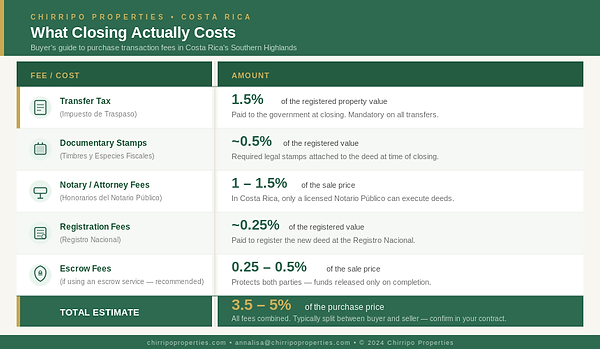
Establish a realistic budget that includes closing costs — typically 3.5–5% of the purchase price on top of what you pay for the land. That covers transfer tax, notary fees, stamps, and registration. More on those numbers below.
Step 2 — Find a real estate agent you actually trust
Costa Rica has no regulated MLS. Listings are scattered across dozens of platforms, and plenty of properties are never publicly listed at all. A good local agent doesn't just show you what's available — they help you understand what you're really looking at: the road access in the rainy season, the water rights situation, the history of a parcel, the neighbor dynamics. That local knowledge is worth far more than any database.
Chirripo Properties works exclusively in the Southern Highlands. We maintain relationships with landowners throughout the canton, including properties that will never appear on a website. When you work with us, you get access to what's actually available — not just what's been listed online.
Step 3 — Hire a Costa Rican attorney/notary
In Costa Rica, real estate transactions are executed by a Notario Público — a licensed attorney with state-authorised notary powers.
Your Notario Público will:
-
Run a full title search at the National Registry (Registro Nacional)
-
Confirm there are no liens, mortgages, legal disputes, or encumbrances
-
Check zoning, SETENA environmental status, and any restrictions on the land
-
Verify property tax payment history
-
Draft and execute the purchase-sale agreement
-
Register the deed transfer at the Registro Nacional in your name
Attorney fees for a standard transaction run 1–1.5% of the purchase price. It is one of the best investments you will make in this process.
Step 4 — Make an offer with an LOI (Letter of Intent)
Once you've found the property, the LOI locks in the agreed price and timeline. This is you officially making an offer with the property owner. After signing an LOI, earnest money deposit — typically 10% of the price — is held in escrow by a reputable escrow company. This protects both parties and gives the process legal structure.
The next step is an SPA (Sale and Purchase Agreement). This is a more detailed contract that may go into due diligence items in greater detail.
Step 5 — Do your due diligence properly
The due diligence period (usually 30–60 days) is when your attorney does the full title investigation. In parallel, you should independently commission:
-
A survey (plano catastrado) to confirm boundaries match the National Registry
-
A topographic study if you plan to build
-
An environmental and water rights assessment for agricultural or eco-tourism properties
-
A structural inspection for any existing buildings
Don't skip the survey. Don't skip the water rights check. These two items alone have saved buyers from some very expensive surprises.
Step 6 — Close
Closing takes place before your Notario Público. Both buyer and seller sign the public deed (Escritura Pública) — or their legal representatives do so with a valid power of attorney. The balance of the purchase price transfers to escrow, is released to the seller, and the deed is submitted to the Registro Nacional. Your name appears on the title, typically within 15–30 business days.
5. How Foreign Buyers Are Protected in Costa Rica
Here's the thing that surprises most people: Costa Rica's property laws are genuinely good. Not 'good for the region' — good by any international standard.
The protections for foreign buyers here are grounded in the constitution, reinforced by decades of consistent jurisprudence, and administered through a public registry that anyone can search. Understanding these protections is what gives you the confidence to move forward — and knowing where the risks actually lie is what keeps you from making a costly mistake.
Constitutional Equal Rights
Article 19 of the Costa Rican Constitution grants foreigners the same property rights as Costa Rican citizens. Full stop. There's no restriction on foreign ownership of titled real estate, no requirement to be a resident or citizen, no nationality quotas, no local-partner requirements. You can buy, own, and sell titled property in Costa Rica on exactly the same terms as someone born here.
The National Registry — Your Best Protection
Every titled property in Costa Rica has a unique folio real registered at the Registro Nacional. That record is public. Your attorney can search it right now and tell you who owns the property, whether there are any debts against it, what the legal boundaries are, and whether there are any encumbrances or disputes attached to it.
That transparency is the single most important protection you have as a foreign buyer. It means you can verify what you're being told before you commit a single dollar. No surprises hiding in the system — as long as you look.
WHAT 'TITLED PROPERTY' MEANS — AND WHY IT MATTERS
In Costa Rica, the strongest form of property ownership is a titulo de propiedad — fee-simple title registered at the National Registry. This is the same type of ownership you'd have in the US, Canada, or Europe. A properly searched and registered title, executed by a licensed Notario Público, gives you full, enforceable legal ownership. Chirripo Properties lists only titled properties. We don't work with possessory rights or informal arrangements.
An Independent Judiciary That Actually Works
Costa Rica has an independent judiciary with a well-established track record of upholding property rights. The Constitutional Chamber — known as the Sala IV — provides an additional layer of protection and is widely regarded as one of the strongest constitutional courts in the region. Foreign owners have equal standing to bring and defend claims in Costa Rican courts.
No Expropriation Without Fair Compensation
The Costa Rican Constitution prohibits the expropriation of private property without fair market compensation. Any government taking must go through a formal legal process with judicial oversight and payment to the owner. This protection applies equally to foreign owners.
Holding Property Through a Corporation
Many foreign buyers in Costa Rica choose to hold their property through a Sociedad Anónima (S.A.) or a Sociedad de Responsabilidad Limitada (S.R.L.) — the Costa Rican equivalents of a corporation and an LLC. The advantages are practical:
-
Ownership transfers by selling shares rather than re-registering the deed — faster and simpler
-
Liability protection for the individual owner
-
Easier estate planning when heirs are in multiple countries
-
Potential tax planning benefits with guidance from a qualified local accountant
Corporate property holding is legal, widely used, and fully recognized by Costa Rican courts and banks.
Currency, Banking, and Moving Money
Costa Rica has no restrictions on transferring foreign currency in or out of the country. US dollars are widely accepted alongside the colón, and most real estate transactions are conducted in USD. Use an escrow service — not a direct wire to a seller or agent — for any significant transfer. Escrow releases funds only when all agreed upon conditions are met and the deed is properly registered. It's a straightforward protection that serious buyers use as a matter of course.
A Note About the Coastal Zone
IMPORTANT: MARITIME ZONE LAW (ZONA MARÍTIMO TERRESTRE)
This guide covers properties in the Southern Highlands — mountains and river valleys, not coastline. But it's worth understanding the coastal law since many buyers compare both. Within 200 metres of Costa Rica's high-tide line, special rules apply: the first 50 metres is public domain and cannot be privately owned; the remaining 150 metres is concession land. Non-residents cannot hold concessions directly. This restriction does not apply to Southern Highlands properties, which are titled in the normal manner. It is, however, a critical reason to do extra-careful legal due diligence on any coastal property.
6. A Region Built for a Different Kind of Life
Something is shifting in the Southern Highlands. You can feel it in the people who are arriving — not tourists passing through, but people who came for a week and started asking about land. They're drawn by the same things, described in different words. A slower pace. Food you can grow yourself. A forest at the end of the garden. A community where people still know each other's names.
This region has been living the eco-tourism and sustainable living model before those phrases became marketing. The quetzals were here before the retreats. The rivers were clean before anyone called it a selling point. That authenticity is exactly what makes it worth arriving for — and exactly what makes sustainable living in Costa Rica's mountains such a different proposition from buying into a resort development.
Eco-Tourism: A Market That Is Just Getting Started
Costa Rica receives over 3 million international tourists a year and consistently ranks as one of the world's top eco-tourism destinations. The Southern Highlands — gateway to Chirripó National Park, the Río Savegre valley, and the cloud forests of the Talamanca range — attract hikers, birdwatchers, scientists, and travellers seeking something real, far from beach clubs and resort pools.
Eco-tourism property in Costa Rica's mountains is still early-stage. Buyers in this region have successfully built:
-
Eco-lodges and boutique nature retreats
-
Yoga and wellness centres embedded in mountain forest
-
Bird-watching operations (the Río Savegre valley is one of the world's top birding sites — home to the resplendent quetzal)
-
Adventure tourism companies offering Chirripó trekking, horseback riding, and river experiences
-
Farm stays and agrotourism blending food, farming, and visitor experience
A property purchased today for personal use or ecological purposes is well-positioned for rental income as the region's visibility grows. The infrastructure is improving. The demand is building. The supply of genuinely special properties is limited.
Conservation and the PSA Programme
Pérez Zeledón sits within the Mesoamerican Biological Corridor — one of the most biodiverse wildlife corridors on Earth, connecting habitat from Mexico to South America. Forest-covered properties in the Southern Highlands may qualify for Costa Rica's Pagos por Servicios Ambientales (PSA) programme — government payments to landowners who conserve forest rather than clear it.
The PSA programme is administered by FONAFIFO and pays landowners per hectare per year for maintaining forest cover, carbon sequestration, and watershed protection. Contracts run 5–10 years and are renewable. For buyers who want to hold forested land responsibly, this programme makes conservation financially viable — and increasingly attractive as carbon markets develop globally.
PSA IN PRACTICE
PSA conservation payments can generate annual income from forested land without any development at all. If you're considering a property with significant forest cover, ask us about FONAFIFO eligibility during due diligence. It can meaningfully change the financial picture of a holding.
Food Production and Agroecology
The volcanic soils and reliable rainfall of the Southern Highlands produce some of Costa Rica's finest agricultural land. Coffee, sugarcane, yuca, plantains, pineapple, avocado, cacao, hearts of palm, turmeric — the list of what grows here is long. For buyers interested in food sovereignty, whether as smallholder farmers, commercial organic producers, or simply people who want to grow their own food, this region is exceptional.
A growing network of agroecological farmers, permaculture practitioners, and organic producers has taken root across the canton — cooperatives, seed-saving groups, farm-to-table operations, and educational farms. Water rights (derechos de agua), regulated by SENARA and AyA, are verified by your attorney during due diligence. A property with a registered water concession carries genuine added value.
Deep Connection to Nature
The Southern Highlands are home to jaguars, tapirs, pumas, ocelots, anteaters, sloths, resplendent quetzals, scarlet macaws, toucans, and hundreds of species of amphibians and reptiles. Rivers running through private farms teem with life. Nights here are quiet enough to hear the forest breathe. Skies are dark enough to show the full Milky Way.
For buyers seeking a daily relationship with the natural world — not as a tourist, but as a resident and steward — this region is without peer. It is possible to live on a farm where quetzals nest in the trees, where rivers provide swimming and drinking water, where food grows twenty metres from the kitchen door. The science on what this does to mental health is growing. Those who live it already know.
7. Mountains vs. Coast: An Honest Comparison
Costa Rica's international profile is dominated by its coastlines. The surf towns, the beach clubs, the resort developments — that's what most people picture when they think 'Costa Rica property.' And the coast has real appeal. But it also has a profile that a lot of buyers don't examine closely enough before committing.
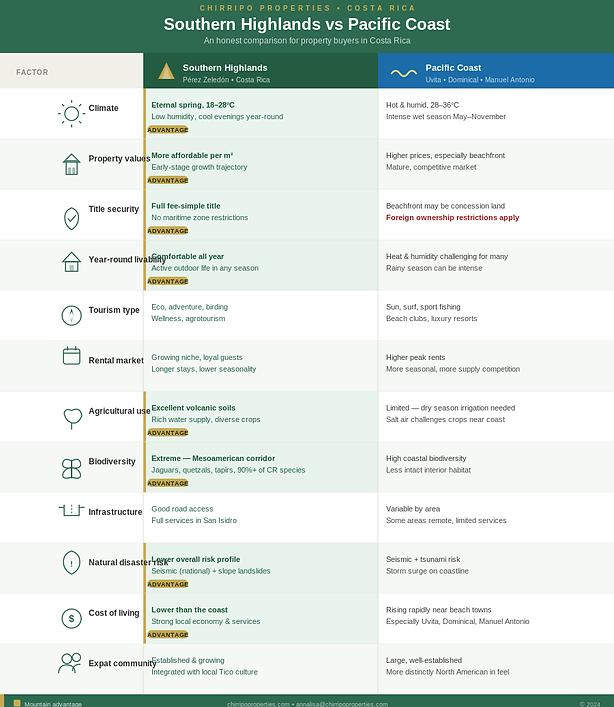
Here's a straight comparison between Costa Rica mountain vs beach property investment — no sales pitch on either side, just the honest differences.
Why the mountains make sense right now
For buyers whose goals include sustainability, food production, eco-tourism, conservation, or a high-quality life at a genuinely affordable cost, the Southern Highlands outperform the coast on almost every metric that matters for the long term.
Property is more affordable. Title is cleaner. The climate is more liveable year-round. The land is more productive. And the buyers and guests this region attracts — conscious travellers, researchers, wellness practitioners, birders, people genuinely seeking something deeper — are a niche that is growing globally and is underserved in Costa Rica's Southern Highlands.
That underservice is a first-mover opportunity. It won't last forever.
Why the coast still makes sense for some buyers
Coastal property near established beach towns — Dominical, Uvita, Ojochal, Manuel Antonio — offers higher peak rental income, a larger established expat community, and strong short-term demand from international beach tourists. If maximum short-term rental income or personal beach lifestyle is the primary goal, the coast is compelling.
Just go in with clear eyes on the legal situation. Coastal property near the ocean may be concession land rather than titled property, with significant restrictions on foreign ownership. Thorough legal due diligence is especially critical there.
The bigger picture
The Southern Highlands today resemble Nosara in the 1990s or Santa Teresa in the early 2000s — extraordinary natural beauty, authentic local culture, and a market that hasn't been discovered yet.
Early buyers in those coastal areas captured appreciation that early sceptics still regret missing. Pérez Zeledón has the same fundamentals: biodiversity, climate, culture, affordability, and infrastructure that is quietly improving. The difference is that the mountains offer something those beach towns eventually lost — the ability to live here without it feeling like a resort.
8. Practical Tips and Things to Watch Out For
It's easy. This section is the one I'd want to hand every buyer before they sign anything. Not to scare you — the process is genuinely manageable — but because a few common mistakes are entirely avoidable when you know what they are.
Do these things
-
Hire a trusted attorney
-
Insist on a full National Registry title search before any money moves beyond a refundable deposit
-
Visit the property in both the dry season (December–April) and the wet season (May–November) if at all possible
-
Verify water rights, road access rights, and any easements independently — don't take the seller's word for any of these
-
Use an escrow service for funds — never wire directly to a seller without escrow protection
-
Ask about the access road in October specifically — that's when you find out what it's really like
Avoid these mistakes
-
Don’t skip a thorough due diligence
-
Don't confuse 'possessory rights' with a registered title — these are entirely different legal instruments with very different protections
-
Don't rely on verbal agreements or informal seller representations — if it's not in writing, it doesn't exist legally
-
Don't overlook SETENA environmental compliance or zoning restrictions if you plan to develop or build
Taxes and ongoing costs

9. Questions Buyers Ask Most Often
These are the real questions — the ones that come up in almost every conversation I have with buyers. Direct answers, no fluff.
Can a foreigner own 100% of property in Costa Rica?
Yes — full stop. Costa Rican law gives foreigners identical property rights to citizens for titled real estate. No local partner required. No nationality restrictions. No cap on foreign ownership percentage.
Do I need to be a resident to buy property?
No. You can purchase, own, and sell titled property in Costa Rica as a non-resident with only a valid passport. Residency is entirely optional and has no bearing on your right to own property here.
How long does the purchase process take?
From signing the Option to Purchase to closing, a straightforward transaction typically takes 30–60 days. Registration of the deed at the Registro Nacional adds another 15–30 business days after closing.
Can I get a mortgage in Costa Rica as a foreign buyer?
Yes, mortgaging with North American lenders is an option as well as direct seller financing.
What's the safest way to transfer money for a purchase?
Wire transfer to a licensed escrow company is the standard — and the right — approach. Escrow holds your funds and releases them only when all agreed conditions are met and the deed is properly registered. Never wire directly to a seller or agent. This is the rule, not the suggestion.
Are there restrictions on what I can build?
Yes. All construction must comply with CFIA engineering standards, municipal zoning plans, and — where applicable — SETENA environmental regulations. Properties near rivers, wetlands, or protected areas have specific setback requirements. Your attorney and a local engineer or architect should review any building plans before you purchase land with the intent to build.
How do I get electricity and water connected?
Electricity is provided by ICE or local ESPH cooperatives. Water typically comes from AyA, a local ASADA (community water cooperative), or a private well. Septic systems are standard in rural areas. Internet via Kolbi or Claro is widely available — fibre-optic in the San Isidro urban area, 4G LTE broadly across the canton.
10. Let's Find Your Property
If this guide has done its job, you're already imagining somewhere specific. A hillside with a river below. A farm facing west into the afternoon sun. A cloud-forest edge where quetzals pass through in April.
That's where we start — not with a listing, but with a conversation about what you actually want and what's honestly available. No pressure. No pitch. Just two people talking about land and what it might become.
Here's how I can help you from here:
